24/7 emergency call-out across North Wales

Restored chimney stack with repointed brickwork and new lead flashing in North Wales

Chimney Restoration
In North Wales
Modern, Heritage And Listed

Chimneys take the worst of the North Wales weather. We restore stacks of every age, modern to heritage and listed, using the right method for the building.

Free survey · fixed-price quotes · cast caps, repointing, rendering and rebuilds

5.0 Google rating

13 reviews

Three generations

family roofing team

25-year guarantee

on every new roof

Fully insured

workmanship guaranteed

24/7 call-out

storm damage & leaks

What Chimney Restoration Involves

A chimney is the most exposed masonry on the building. It stands proud of the roof on every side, it is wetted from all four faces, and it is the one part of the structure with no roof of its own over it. That is why a stack usually fails long before the walls of the house it sits on.

Restoration means dealing with the whole stack rather than the one course that looks worst from the ground: the cap or flaunching at the top, the pointing through the exposed brick or stone, the render where the stack is rendered, the flashings where it passes through the roof, and the structural condition of the masonry itself.

We survey the stack from safe access, photograph it, and tell you which of those parts are still doing their job and which are not. Sometimes the answer is a cast cap and a repoint. Sometimes the top half needs taking down and rebuilding. You get the findings and a fixed price before anything is committed to.

What We Offer

  • Cast chimney caps, made to measure for any chimney
  • Chimney repointing: traditional sand and cement, or lime pointing for heritage and listed work
  • Chimney rendering: traditional sand and cement, or the flexible Weber render system
  • Full stack repairs and rebuilds
  • Lead flashings, soakers and back gutters renewed around the stack
Book the free survey

What A Failing Stack Does To The House

Damp on a chimney breast is almost never a coincidence. Water gets in at the top through an open or cracked flaunching, soaks down through the brickwork, and shows up on the plaster in the bedroom below. The stain appears a long way from the defect, which is why it is so often mistaken for rising damp or condensation.

Once the pointing has gone, frost does the rest. Water sits in the open joints, freezes, and pushes the face off the brick or the stone. Every winter takes a little more, and a stack that needed repointing becomes a stack that needs rebuilding.

In the worst cases the masonry loses enough bond that the stack starts to lean, and a leaning chimney on an exposed North Wales roof in a January gale is a genuine safety problem, not just a maintenance one.

Where People Go Wrong

  • Patching one visible joint from a ladder instead of raking out and repointing the whole exposed stack.
  • Using hard sand and cement pointing on soft heritage or listed masonry, which traps moisture and blows the face off the stone.
  • Slapping mortar over failed flaunching rather than casting a proper cap that sheds water clear of the brickwork.
  • Sealing a stack with waterproof coating so it cannot dry out, then wondering why the damp gets worse.
  • Cement fillets instead of lead flashings where the stack meets the roof: they crack within a couple of winters.
  • Rebuilding the top few courses and leaving the rotten flashings underneath untouched.

How A Chimney Restoration Runs

Step 1: Free survey of the stack

We get up to the chimney rather than judging it from the ground, photograph every face, the cap, the pointing and the flashings, and identify what is actually letting water in.

Step 2: Written findings and fixed price

You get the photographs, a plain account of what has failed, and a fixed-price quote covering the work: same day as the visit or the day after.

Step 3: Access and protection

Scaffold or tower access is set up so the stack can be worked on properly from all sides, with the roof covering below protected from dropped debris.

Step 4: The restoration itself

Raking out and repointing in the right mortar, casting the cap, rendering where specified, or taking the stack down and rebuilding it course by course, then renewing the lead work around the base.

Step 5: Clear down and check

Debris cleared, gutters checked for mortar, the finished stack photographed from access, and the site left as we found it.

Why It Is Worth Doing Properly

Made-to-measure caps

Caps are cast to fit your chimney rather than adapted from a stock size, so water is thrown clear of the masonry.

The right mortar for the building

Sand and cement where it belongs, lime where the building needs to breathe. Heritage and listed stacks are not pointed like a modern one.

Rendering options

Traditional sand and cement render, or the flexible Weber system where movement and exposure make a more forgiving finish the better choice.

The whole stack, not a patch

Cap, pointing, render, masonry and flashings are dealt with together, so the water has nowhere left to get in.

Photographed before and after

You see the stack as we found it and as we left it, because almost nobody can inspect their own chimney.

Fixed price, no surprises

The quote is the price. If we find something behind the render that changes the job, you see it photographed and priced before we carry on.

Recent Chimney Restoration Work

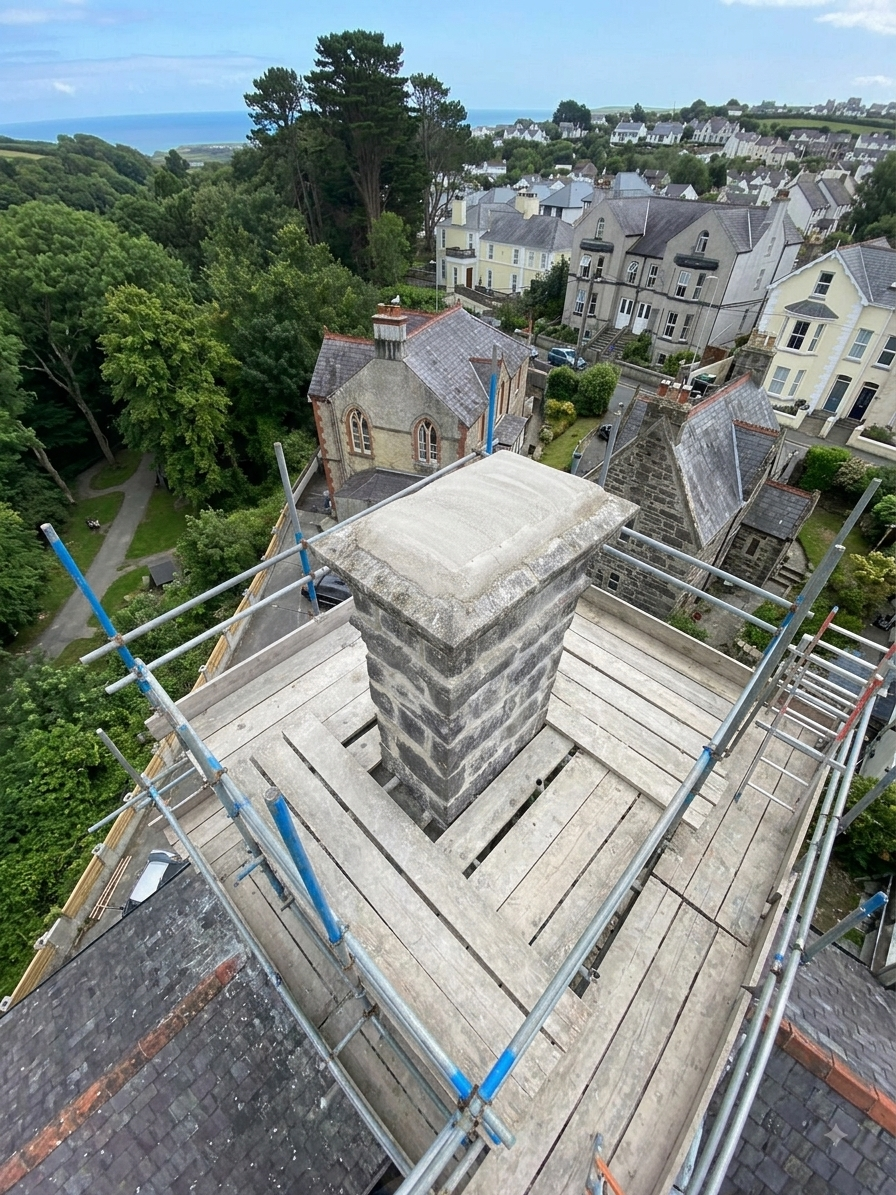
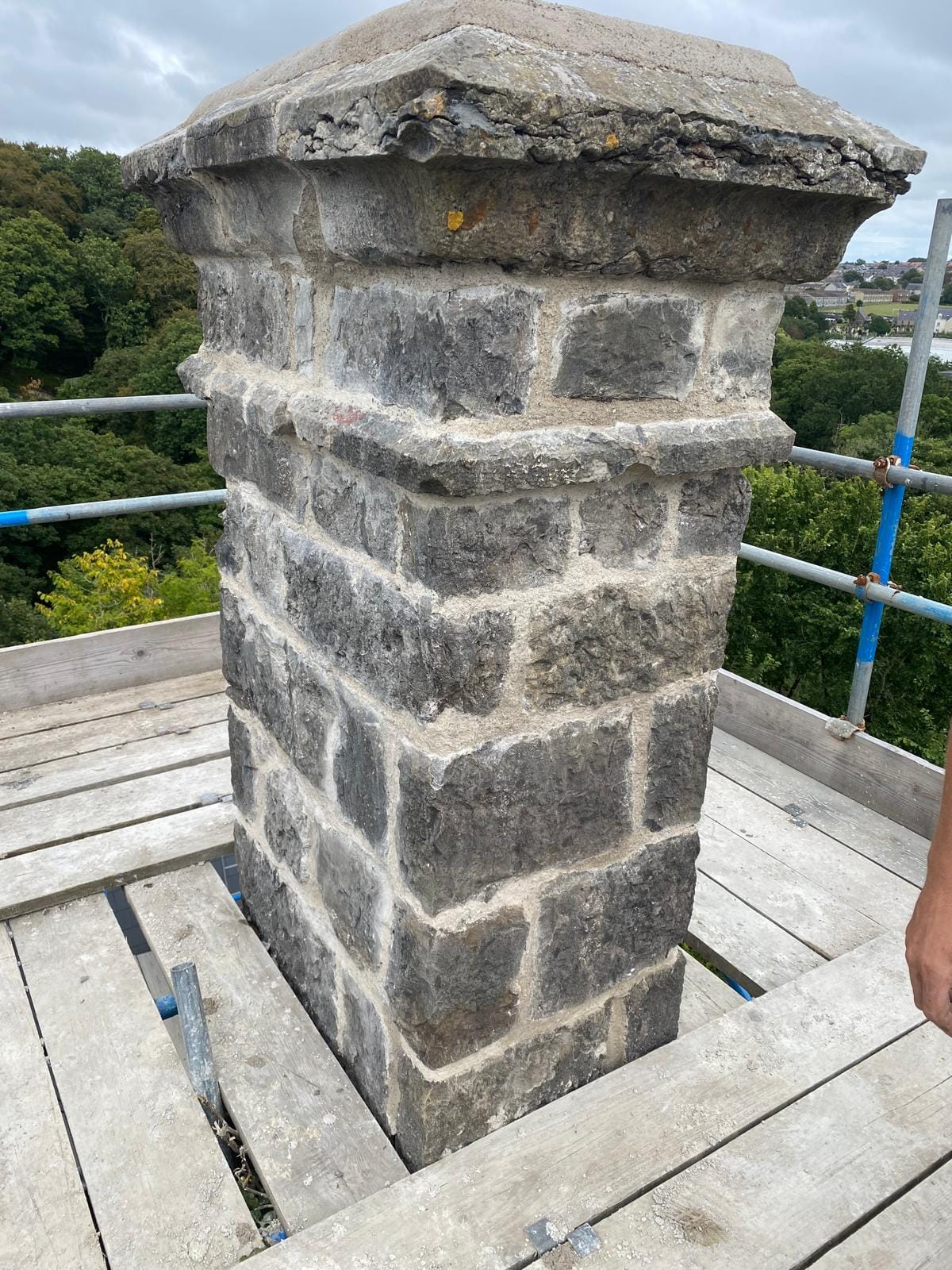
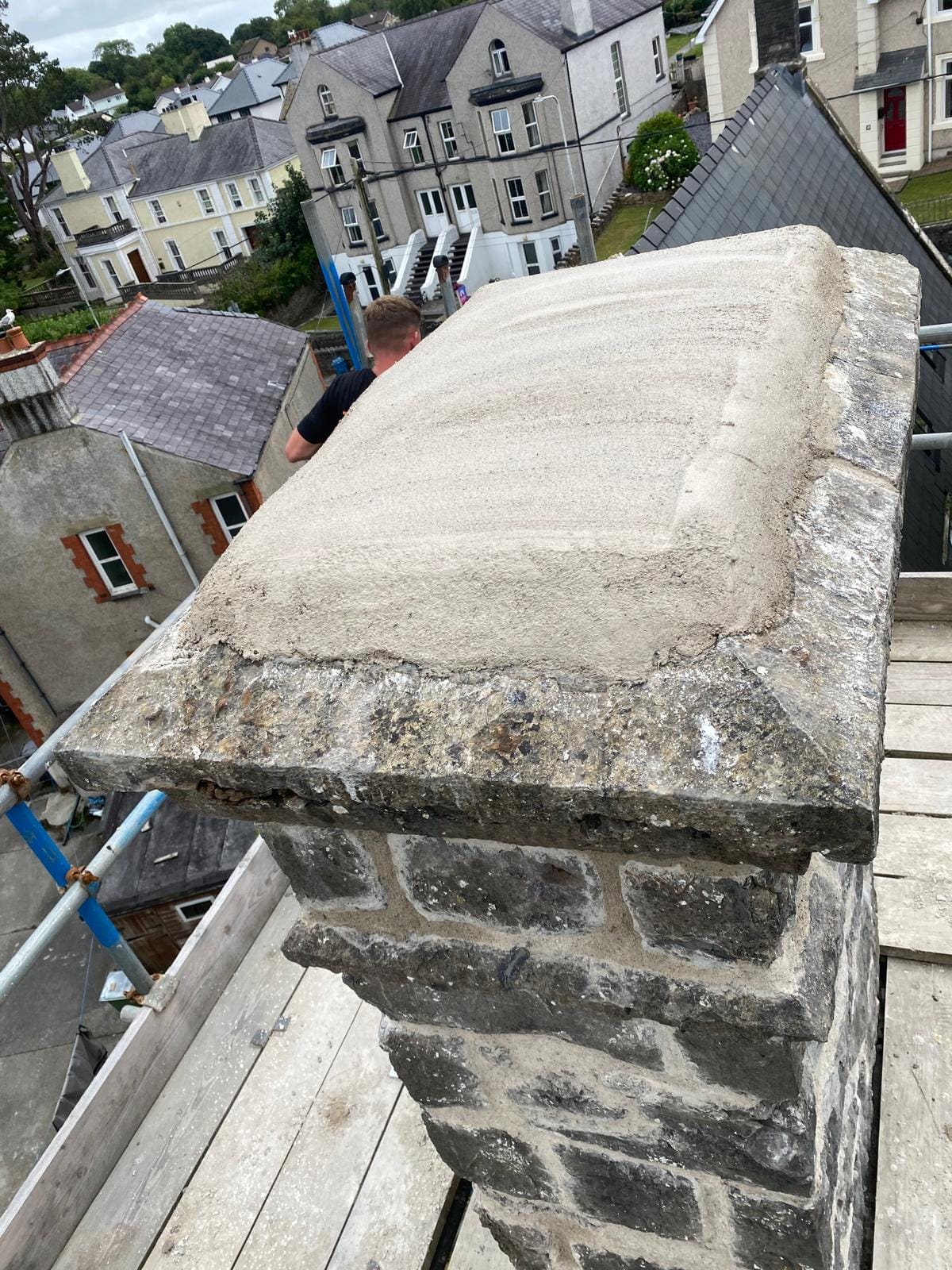
Damaged chimney stack before repair by North Wales Roof Repairs in North WalesRepointed chimney stack with new lead flashing after repair, North Wales

Chimney Work In Detail

Cast chimney caps

The flaunching, the sloped mortar bed that holds the pots and sheds water off the top of the stack, is the single most common point of failure. It is a thin mortar detail, fully exposed, and once it cracks the whole stack starts to fill with water from above.

Rather than repeatedly re-flaunching, we cast a chimney cap made to measure for your stack, with the openings sized to your pots and a proper overhang and drip so rainwater is thrown clear of the brickwork instead of running down the face of it. It is a far longer-lived answer to the same problem.

Repointing: sand and cement or lime

On modern brick stacks, joints are raked out to a sound depth and repointed in a traditional sand and cement mortar, finished to match the existing joint profile so the chimney does not end up looking like a repair.

On heritage and listed buildings, and on soft stone and old lime-bedded brick, we point in lime. A lime mortar is softer than the masonry around it and stays vapour-open, so the stack can dry out and any movement is taken up by the joint rather than by the face of the stone. Using hard cement on those buildings does real and permanent damage, which is why the method is chosen to suit the building rather than to suit the van.

Rendering: traditional and Weber

Rendered stacks are common across North Wales and on the Anglesey and Conwy coast, where render was used to keep driven rain out of exposed masonry. When it cracks or hollows, water gets behind it and the render then holds the wet against the brick instead of keeping it off.

We remove failed render back to sound masonry and re-render in traditional sand and cement, or in the Weber render system where a more flexible, water-shedding finish suits the exposure and the movement of the stack. Both are finished to blend with the rest of the building rather than left as an obvious patch.

Full repairs and rebuilds

Where frost and saturation have taken the bond out of the mortar and the face off the brick, repointing is no longer enough. In that case the stack is taken down to a sound course, the reusable brick or stone is set aside, and it is rebuilt with matching materials, a proper cap and new pots or terminals as needed.

Rebuilds are the point at which the flashings should always be renewed too, because the stack is accessible and the roof covering around it is already lifted. New lead soakers, front apron, side step flashings and a back gutter go in as part of the work across Bangor, Llangefni, Anglesey, Caernarfon, Conwy, Llandudno, Colwyn Bay, Denbigh and Betws-y-Coed.

Free survey & quote

Always free, always in writing, back to you same day or next.

Fixed price

Quoted as a fixed price, not a day rate. No creeping costs.

Guaranteed work

Workmanship guaranteed on all jobs. 25 years on new roofs; flat-roof warranties per manufacturer system.

Straight Answers

The questions we are asked most about chimney restoration across North Wales.

Ask us directly on 07538 586813
How do I know if my chimney needs restoring?

Common signs are damp on the chimney breast inside, mortar or brick fragments in the gutter, open joints and a cracked or missing flaunching at the top. The only way to be sure is to get up to it, which is what the free survey is for.

What is a cast chimney cap?

A cap cast to measure for your stack that replaces the old mortar flaunching, sized around your pots and formed with an overhang so rainwater is thrown clear of the brickwork rather than running down it.

Should my chimney be pointed in lime or in sand and cement?

It depends on the building. Modern brick stacks are pointed in sand and cement; soft stone, old lime-bedded masonry and heritage or listed buildings should be pointed in lime so the stack can breathe and move.

What is the Weber render system?

A proprietary render system that stays more flexible than a traditional sand and cement render, which suits exposed stacks where movement tends to crack a rigid finish.

Can you repair the chimney rather than rebuild it?

Wherever the masonry is sound enough, yes. Repointing, a new cast cap and new flashings will often deal with the problem. We only recommend a rebuild when the brick or stone itself has gone.

Do you renew the lead flashings around the stack?

Yes, and on a rebuild we would always advise it. Cement fillets around a chimney crack within a couple of winters and are one of the most common causes of damp on a chimney breast.

Do you work on listed buildings?

Yes. Heritage and listed stacks are restored with lime pointing and traditional detailing to suit the building.

How much does chimney restoration cost?

It depends on the height of the stack, the access needed and how much of it is being restored. The survey and the fixed-price quote are free, so you get a real number rather than an estimate.

Book Your Free Survey
And Get A Fixed Price

Tell us what the roof is doing and we will come and look at it. You get photographs, a written account of the problems and a fixed-price quote, with no obligation to go ahead.

  • Free survey and written findings with photographs
  • Fixed-price quote same day or the day after the visit
  • Workmanship guaranteed; 25 years on a new roof
  • 5.0 from 13 Google reviews across North Wales

Roof leaking right now?

07538 586813

24/7 emergency call-out across North Wales.

Call nowFree survey