24/7 emergency call-out across North Wales

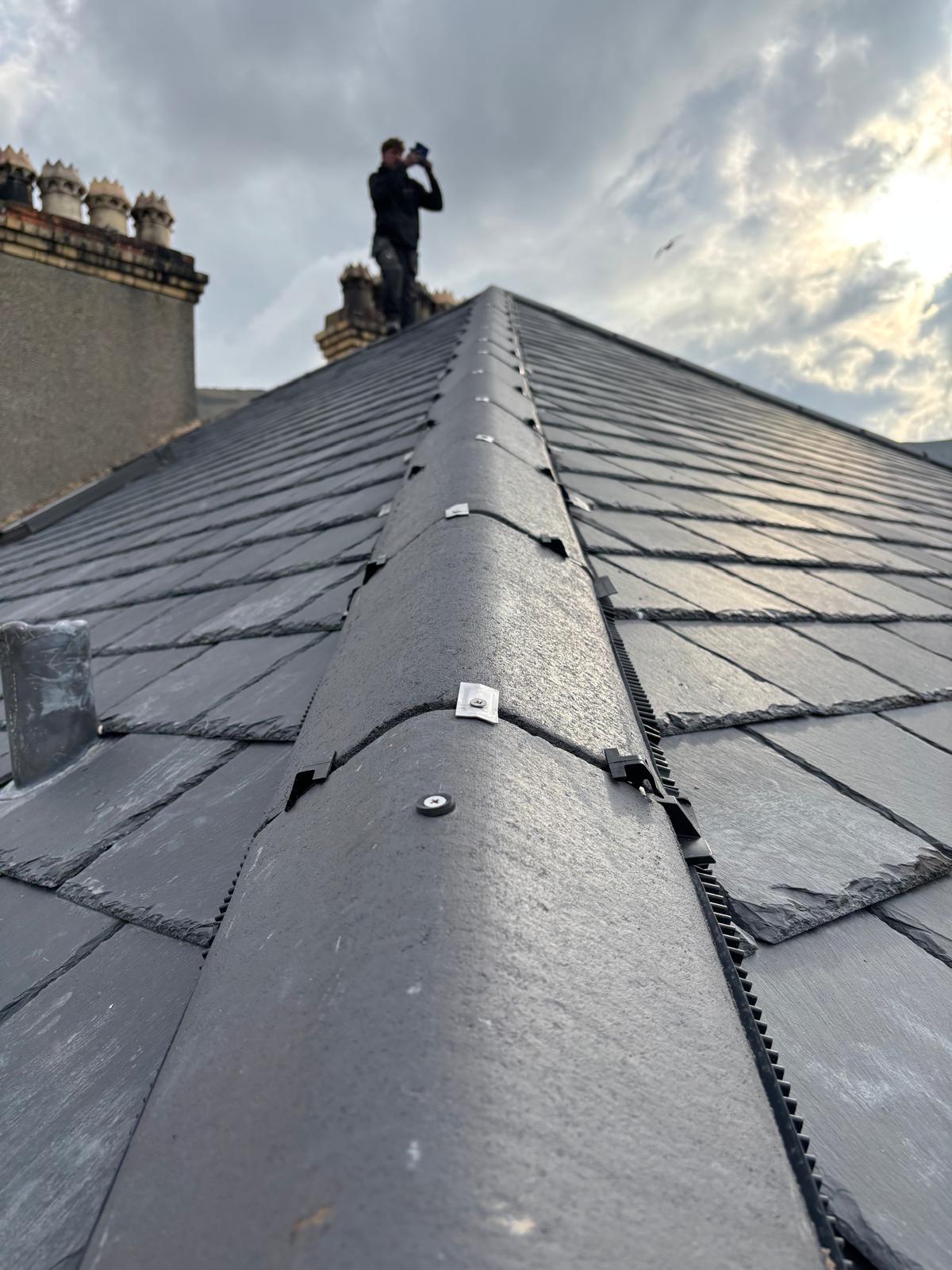
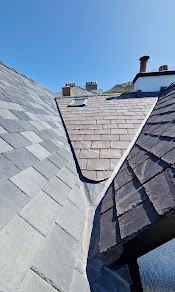
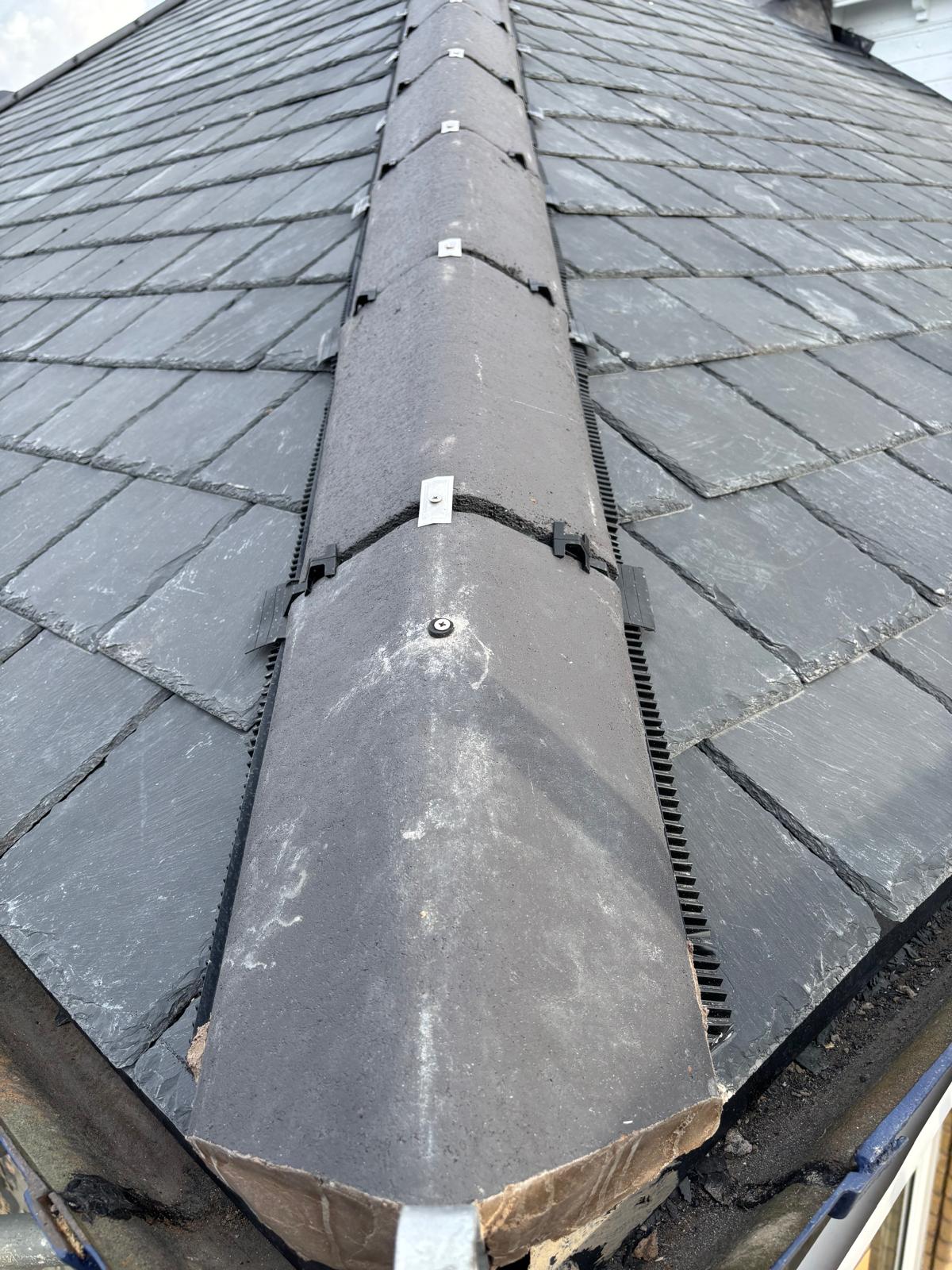
Natural slate roof with clipped ridge detail on a North Wales property

Slate Roofing In North Wales
Reclaimed Welsh Slate Laid
The Way It Should Be

Slate sorted, graded and hung correctly by a family firm that has worked on listed buildings in Betws-y-Coed. Free survey, fixed-price quote, and 25 years' guarantee on a new slate roof.

Reclaimed Welsh slate specialists · listed-building experience · 5.0 Google rating

5.0 Google rating

13 reviews

Three generations

family roofing team

25-year guarantee

on every new roof

Fully insured

workmanship guaranteed

24/7 call-out

storm damage & leaks

Slate Roofing, Properly Understood

Slate is the traditional covering across North Wales, and it is unforgiving of shortcuts. A slate roof works because every slate is the right thickness, holed in the right place, hung at the right gauge and covered by two courses above it. Get the headlap wrong for an exposed coastal elevation and the roof will let water past in driven rain even though nothing looks broken from the ground.

We install and repair reclaimed Welsh slate, new natural slate from Spanish, Chinese and Brazilian quarries, and artificial slate. On period and listed properties, reclaimed Welsh slate is usually the right answer; it matches the surrounding roofscape and it is a genuinely long-lived material. On newer buildings or tighter budgets, a good new natural slate or a quality fibre-cement slate gives a clean, consistent finish.

The work ranges from replacing a handful of slipped slates to stripping and relaying a full roof in reclaimed slate with new lead, membrane and battens. In every case the survey comes first, in writing, with photographs.

Who This Is For

  • Owners of Welsh stone and slate properties needing a like-for-like roof
  • Listed building and conservation-area owners who need a matched, traditional finish
  • Anyone whose slate roof is shedding slates after every storm: usually nail fatigue
  • Buyers of period property whose survey flags delaminating or slipped slate
  • Owners of newer homes wanting slate rather than tile on a reroof
Book the free survey

How Slate Roofs Fail, And What It Costs

Slate itself outlives most of what holds it up. What usually fails first is the nail: a century of damp turns a ferrous nail to nothing, the slate loses its fixing and slides. Once nail fatigue is general, individual repairs simply move the problem along the roof, and every gale takes another few.

The second failure is delamination: slate splitting into thin flakes, particularly on poorer imported slate laid in the last few decades. Once slate is flaking it holds water, breaks in frost and cracks underfoot, and any repair on it damages the courses around it.

Leave either and the pattern is the same: water gets to the battens, the battens rot, the rafter feet follow, and a roof that could have been stripped and relaid on sound timber becomes a structural job with a much bigger bill.

Common Slate Mistakes

  • Mixing thin and thick reclaimed slate at random, which gives a wavy, uneven roof plane.
  • Laying slate to a standard gauge on an exposed coastal elevation that needs a longer headlap.
  • Nailing slate too tight so it cannot move, which cracks it at the hole within a couple of winters.
  • Using mastic and tingle-free bodges to hold slipped slates rather than refixing properly.
  • Cutting valleys and hips badly, so the cut slate is too narrow to sit securely.
  • Reusing old, corroded nails or the wrong nail type, guaranteeing an early second failure.

How A Slate Roof Job Runs

Step 1: Survey and slate assessment

We identify the slate type, measure the existing gauge and headlap, check fixings, look for delamination, and inspect valleys, verges and lead. In the loft we look at the underside of the slate, the battens and the membrane.

Step 2: Written findings and specification

You get photographs and a written account of what is failing and why, with a specification: slate type and size, batten gauge, membrane, headlap for your exposure, and lead codes at each junction.

Step 3: Fixed-price quote

One price for the work described, back to you the same day or the day after the visit. Where reclaimed slate is being reused, we tell you the expected salvage rate honestly before you commit.

Step 4: Strip, sort and lay

Slate is stripped carefully, sorted and graded by thickness, and holed to suit. New membrane and treated battens go on, then the slate is laid with the heaviest at the eaves, courses set out to give straight lines and correct laps throughout.

Step 5: Details, check and guarantee

Valleys, abutments and chimneys are leaded in the correct code, ridges finished in mortar or dry-fix, verges pointed. We check the roof over, clear the gutters and site, and issue your guarantee: 25 years on a new roof.

Why Slate Done Right Pays

A roof measured in decades

Good slate on sound battens with the correct fixings is one of the longest-lived roof coverings there is.

It matches the street

Reclaimed Welsh slate keeps a period property looking like a period property, which matters in conservation areas and at sale.

Weather-correct detailing

Headlap and gauge are set for your elevation and exposure, not to a generic table, so driven rain stays outside.

Honest salvage figures

If only 60% of your existing slate is worth reusing, you are told that before the job starts, not after.

Heritage-safe workmanship

Experience on multiple listed buildings in Betws-y-Coed and on William's own listed home in Llangefni.

Guaranteed

Workmanship guaranteed on all slate work; 25 years on a new slate roof.

Recent Slate Roofing Work

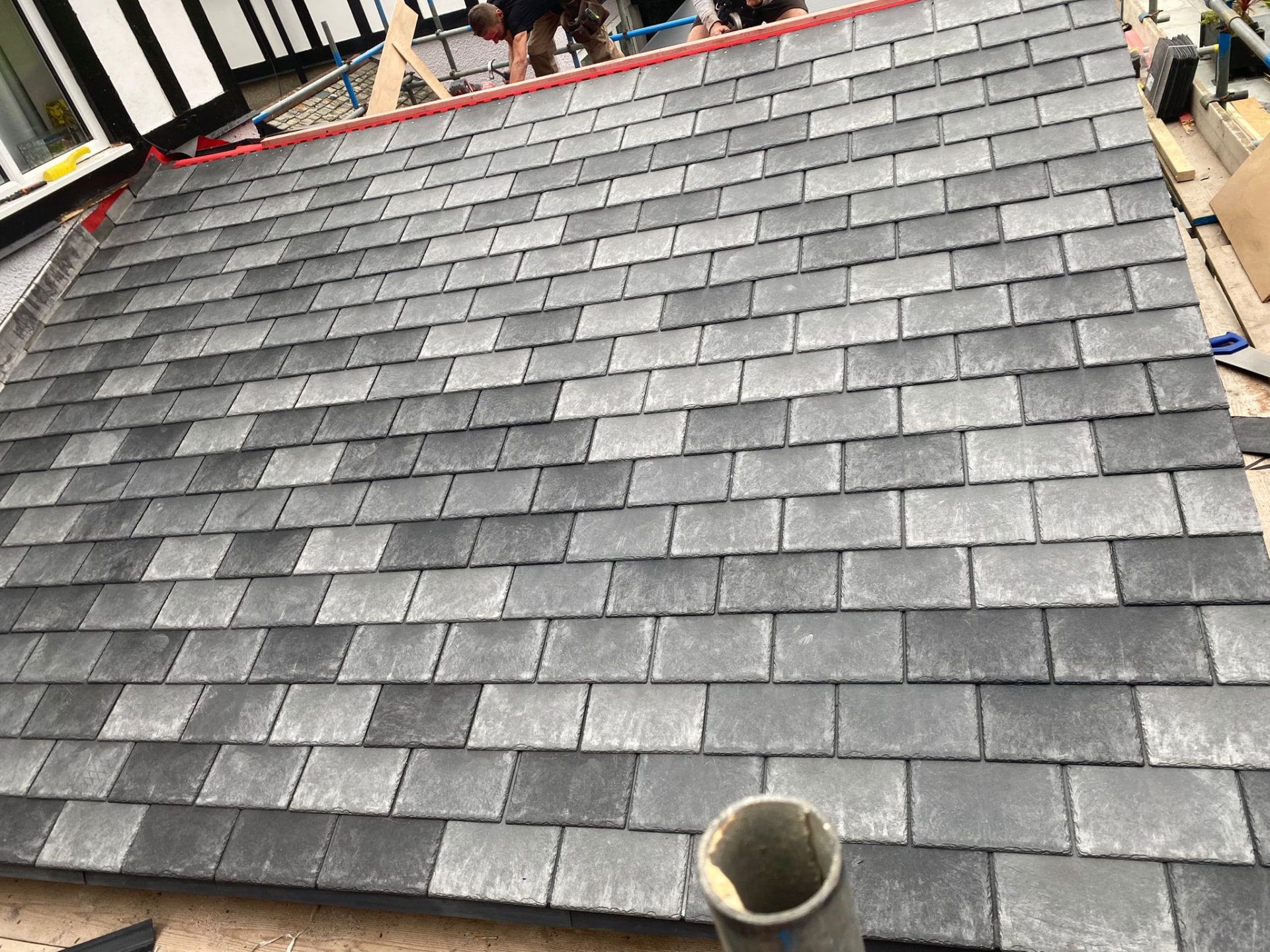
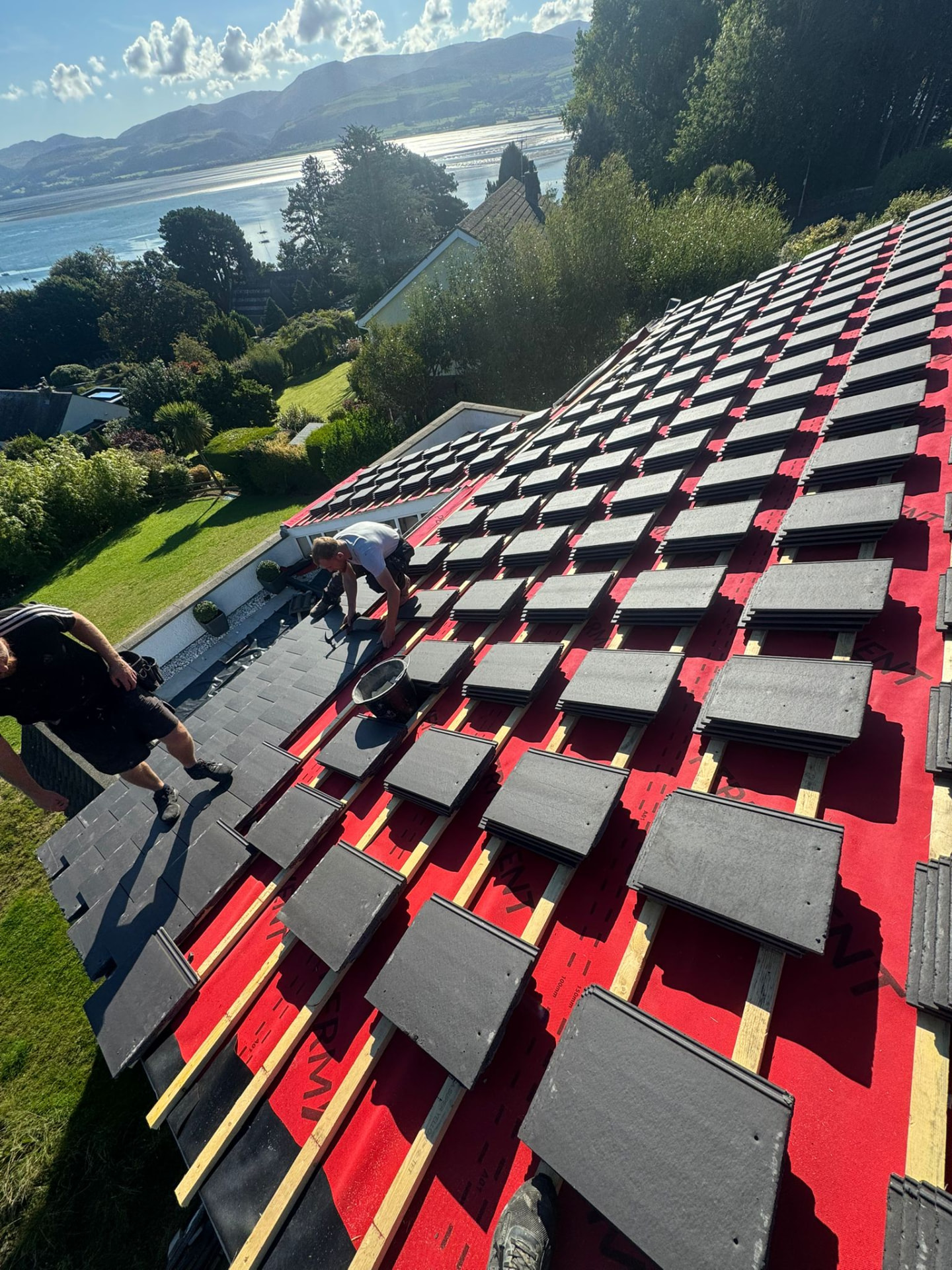
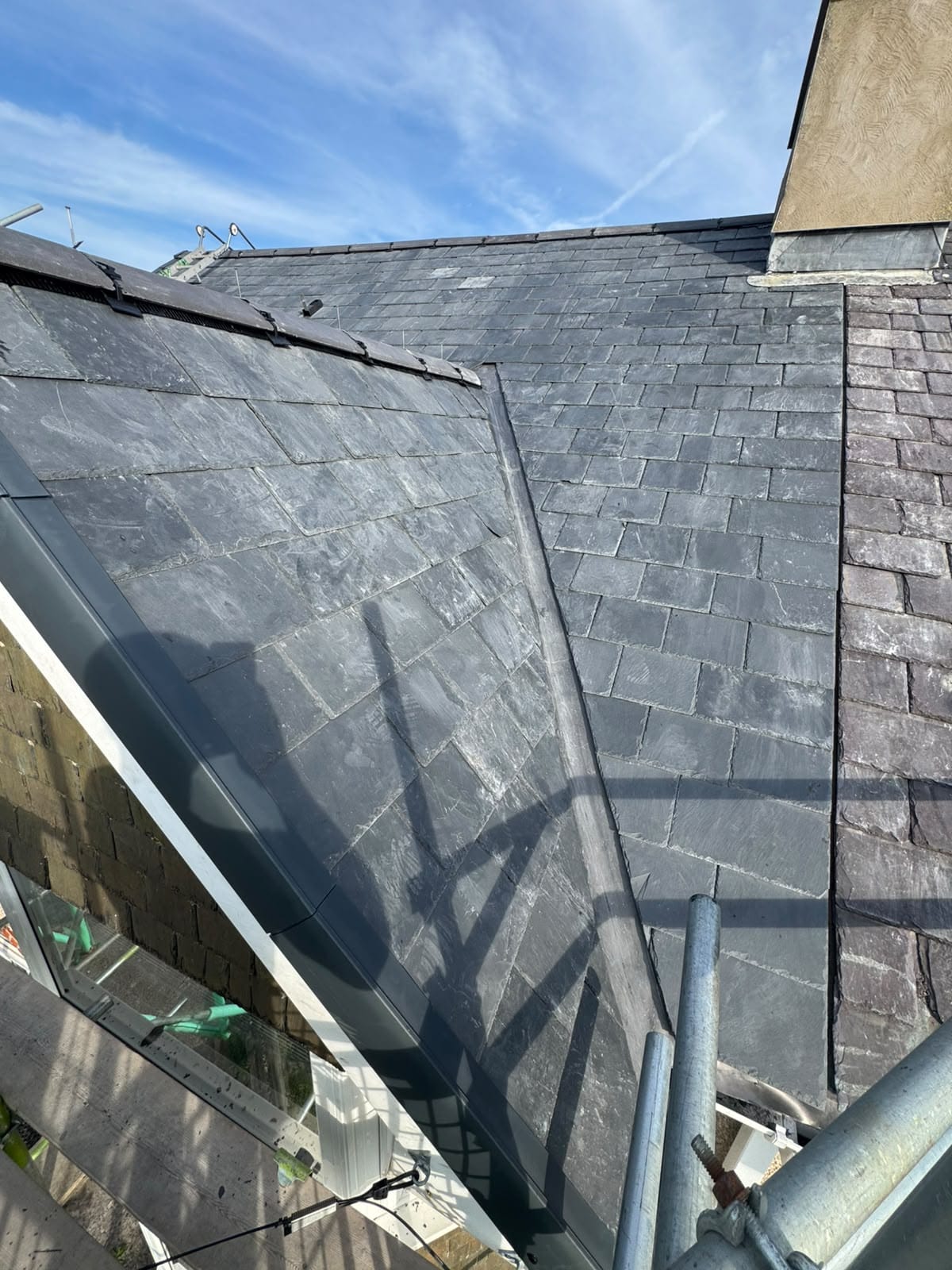
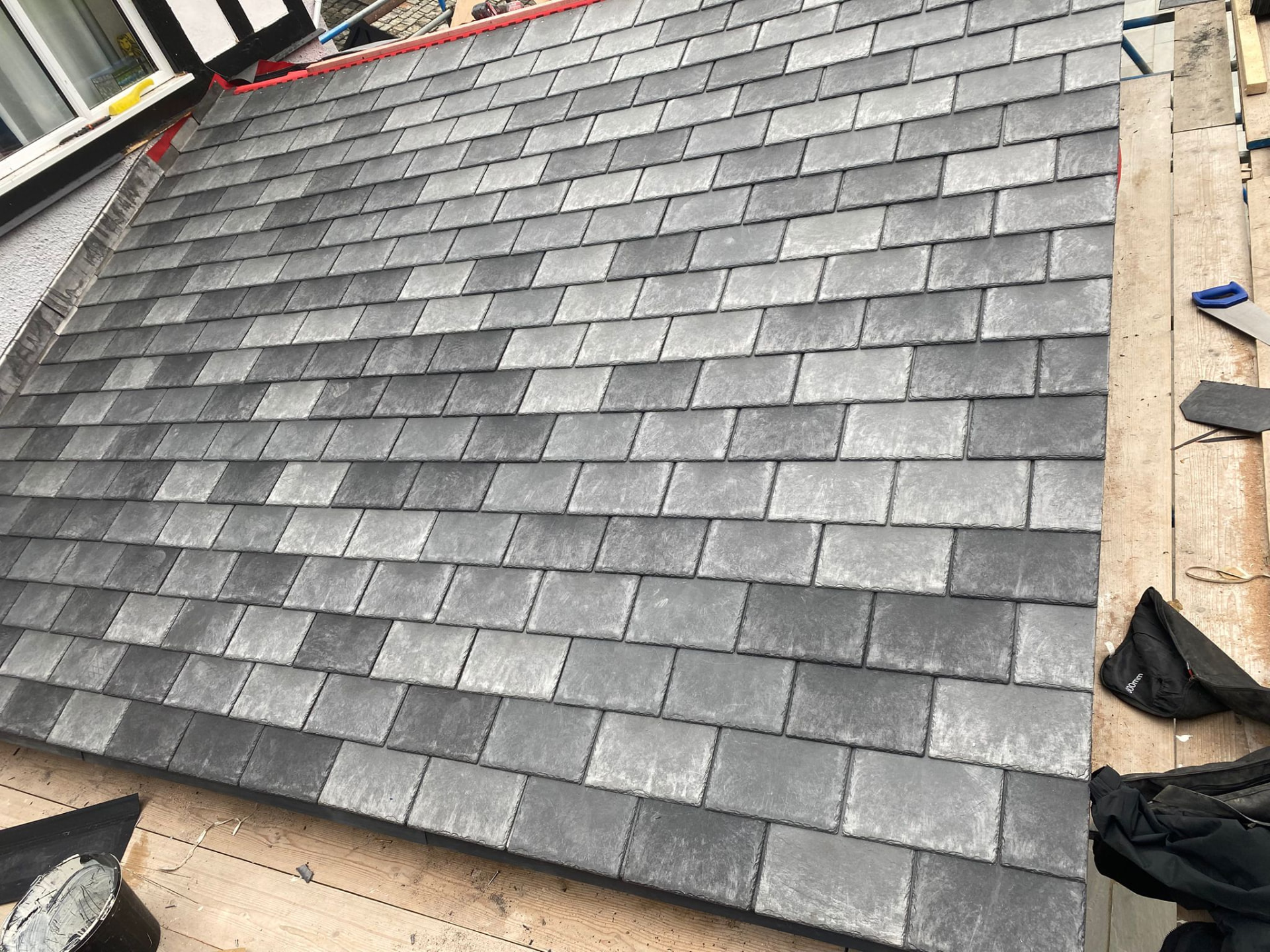
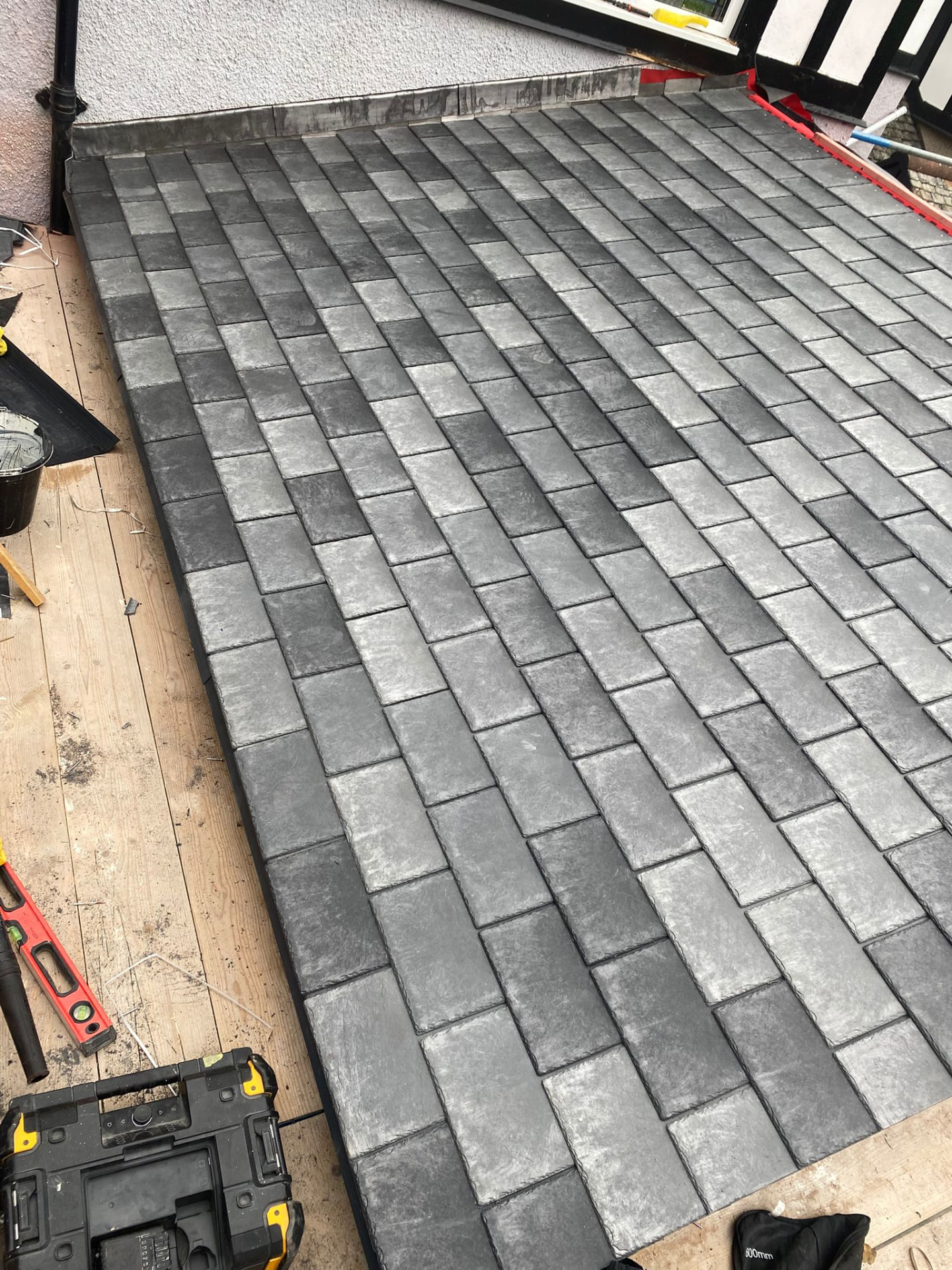
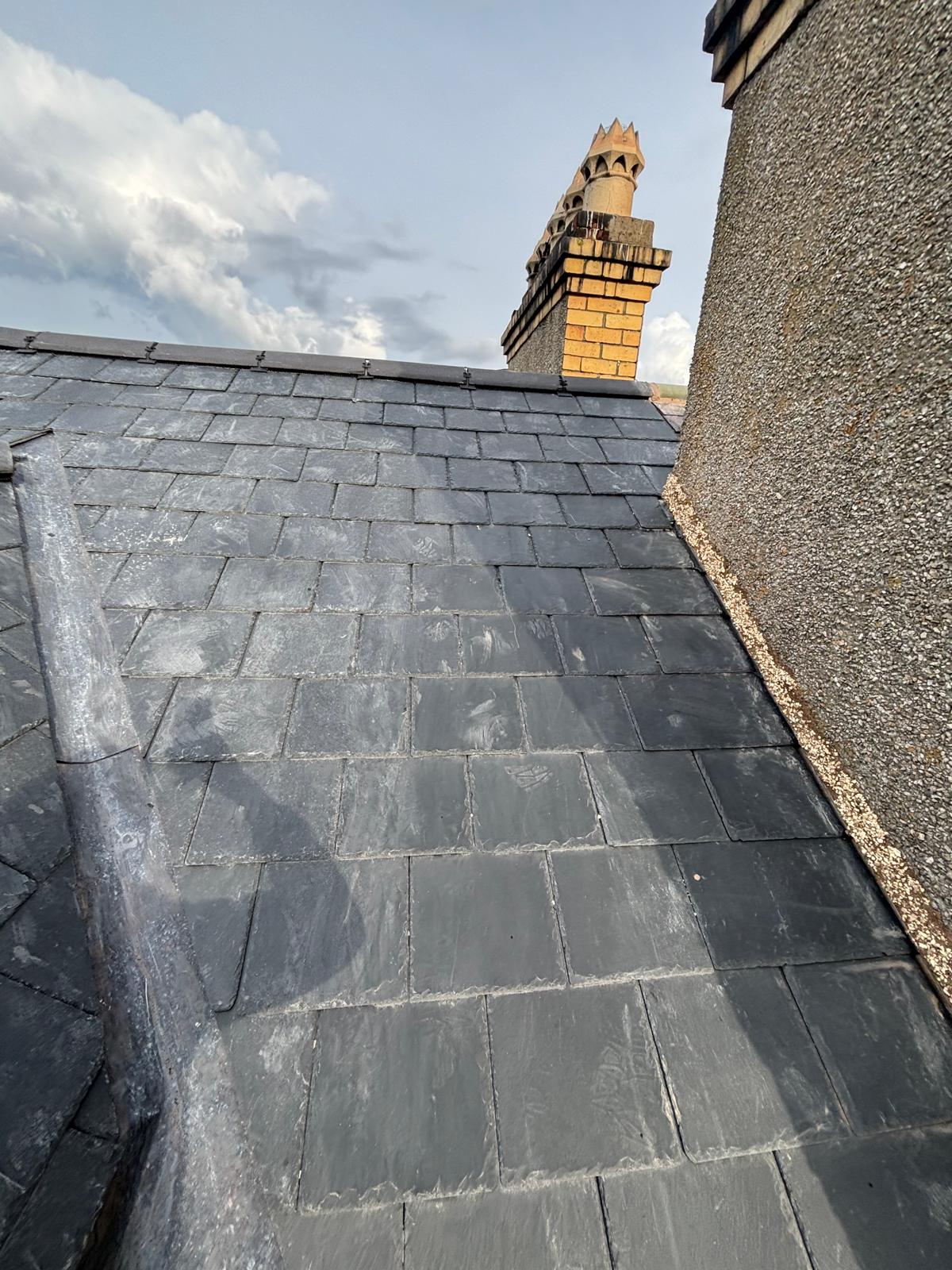
Roofers laying new Welsh slate tiles on a re-roof in North WalesRoofers laying new Welsh slate tiles on a re-roof in North WalesCompleted natural slate roof with neat ridge tiles and lead detailingCompleted natural slate roof with neat ridge tiles and lead detailingCompleted natural slate roof with neat ridge tiles and lead detailingCompleted natural slate roof with neat ridge tiles and lead detailingCompleted natural slate roof with neat ridge tiles and lead detailingCompleted natural slate roof with neat ridge tiles and lead detailing

Slate Types, Details And Applications

Reclaimed Welsh slate

Reclaimed Welsh slate is the standard for period property in Gwynedd, Anglesey, Conwy and Denbighshire. Sourced properly it is sound, dense slate that has already proven itself for a century. Sorting is the whole job: slate is graded by thickness and size, damaged and delaminating pieces are discarded, and the heaviest is laid low on the roof where the weather load is greatest.

Because reclaimed slate comes in mixed sizes, setting out matters: courses have to be planned so that lines stay straight and laps stay correct as sizes change up the roof. That is the difference between a reclaimed roof that looks like the original and one that looks patched.

New natural and artificial slate

New Spanish, Chinese and Brazilian slate covers most budgets, with quality varying widely by grade and quarry: thickness, sound when tapped and iron content all matter, and we specify accordingly. New natural slate gives a very consistent finish and is the usual choice where reclaimed supply is limited or the building is modern.

Artificial and fibre-cement slate is lighter, cheaper and dimensionally perfect. It suits lower-pitched roofs, structures that cannot take the weight of natural slate, and budgets where a full natural reroof is out of reach. We will tell you plainly where it is appropriate and where it will look wrong.

Details that decide whether a slate roof lasts

Valleys, whether lead-lined open valleys or swept and laced work on traditional roofs, take the concentrated flow off two pitches. Abutments and chimneys need stepped flashings and soakers in the correct lead code. Verges need to be properly pointed or dry-verged so wind cannot get under the edge slate.

Fixings are chosen for the location: copper or stainless where the atmosphere is salt-laden, which on Anglesey and the Conwy coast is most of the time. Nails are driven so the slate hangs, not so it is clamped; a slate that cannot move cracks.

Repair, patch or relay

If fixings are generally sound and the slate is not delaminating, individual slipped slates are refixed and the roof carries on. Where one elevation has failed but the others have not, relaying a single elevation is often the right economic answer, reusing sound slate from that pitch.

Where nail fatigue is general or slate is flaking across the roof, a full strip and relay is the only work that ends the problem. We will tell you which of the three you are looking at and why, and we will not sell you a reroof you do not need.

Free survey & quote

Always free, always in writing, back to you same day or next.

Fixed price

Quoted as a fixed price, not a day rate. No creeping costs.

Guaranteed work

Workmanship guaranteed on all jobs. 25 years on new roofs; flat-roof warranties per manufacturer system.

Straight Answers

The questions we are asked most about slate roofing across North Wales.

Ask us directly on 07538 586813
How much does a slate roof cost?

Cost depends on slate type, roof size and pitch, access and the amount of lead work involved. Reclaimed Welsh slate, new natural slate and artificial slate sit at different price points; we survey, then give you one fixed price for the specification agreed.

How long does a slate roof last?

Good natural slate on sound battens with correct non-ferrous fixings lasts for decades: typically it is the nails and battens that decide the roof's life, not the slate. A new slate roof from us is guaranteed for 25 years.

Can my existing Welsh slate be reused?

Frequently, yes. We sort and grade it at strip-out and tell you the salvage percentage; the balance is made up with matched reclaimed slate so the roof stays consistent.

What is nail fatigue?

It is corrosion of the original fixing nails after decades of damp. The slate is still fine but has nothing holding it, so slates begin slipping across the whole roof. Once it is general, patching is money wasted.

Do you work on listed buildings and in conservation areas?

Yes. We have worked on multiple listed buildings in Betws-y-Coed, and reclaimed Welsh slate work on heritage property is a specialty.

Is artificial slate any good?

For the right building, yes; it is light, consistent and cost-effective. On a period stone property it will usually look wrong, and we will say so rather than take the order.

How quickly can you replace slipped slates?

Individual slipped slates are typically a same-day repair. We also run a 24/7 emergency call-out for storm damage across North Wales, typically £150–£250 depending on time and location.

Do you survey before quoting?

Always, and it is free. You get photographs, written findings and a fixed-price quote the same day as the visit or the day after.

Book Your Free Survey
And Get A Fixed Price

Tell us what the roof is doing and we will come and look at it. You get photographs, a written account of the problems and a fixed-price quote, with no obligation to go ahead.

  • Free survey and written findings with photographs
  • Fixed-price quote same day or the day after the visit
  • Workmanship guaranteed; 25 years on a new roof
  • 5.0 from 13 Google reviews across North Wales

Roof leaking right now?

07538 586813

24/7 emergency call-out across North Wales.

Call nowFree survey